

I first heard The Ride of the Valkyries from the family box, at the age of nine, in a velvet chair that had been ours for four generations, and until quite recently I assumed that this was how everybody first heard it.
That is until last week, when I put the question to the Earth liason officer here in Barrel Town, as one might ask after a mutual acquaintance, and every answer that came back through the post-portal gave the same answer. They had first heard it sung by a small bald hunter in a horned helmet, chasing a rabbit.
“Kill the wabbit,” one of our staff (whose last name is Charvein) then sang at me, to the tune, and the rest of the room joined in. I have not been so thoroughly outnumbered since the morning I arrived in Barrel Town.
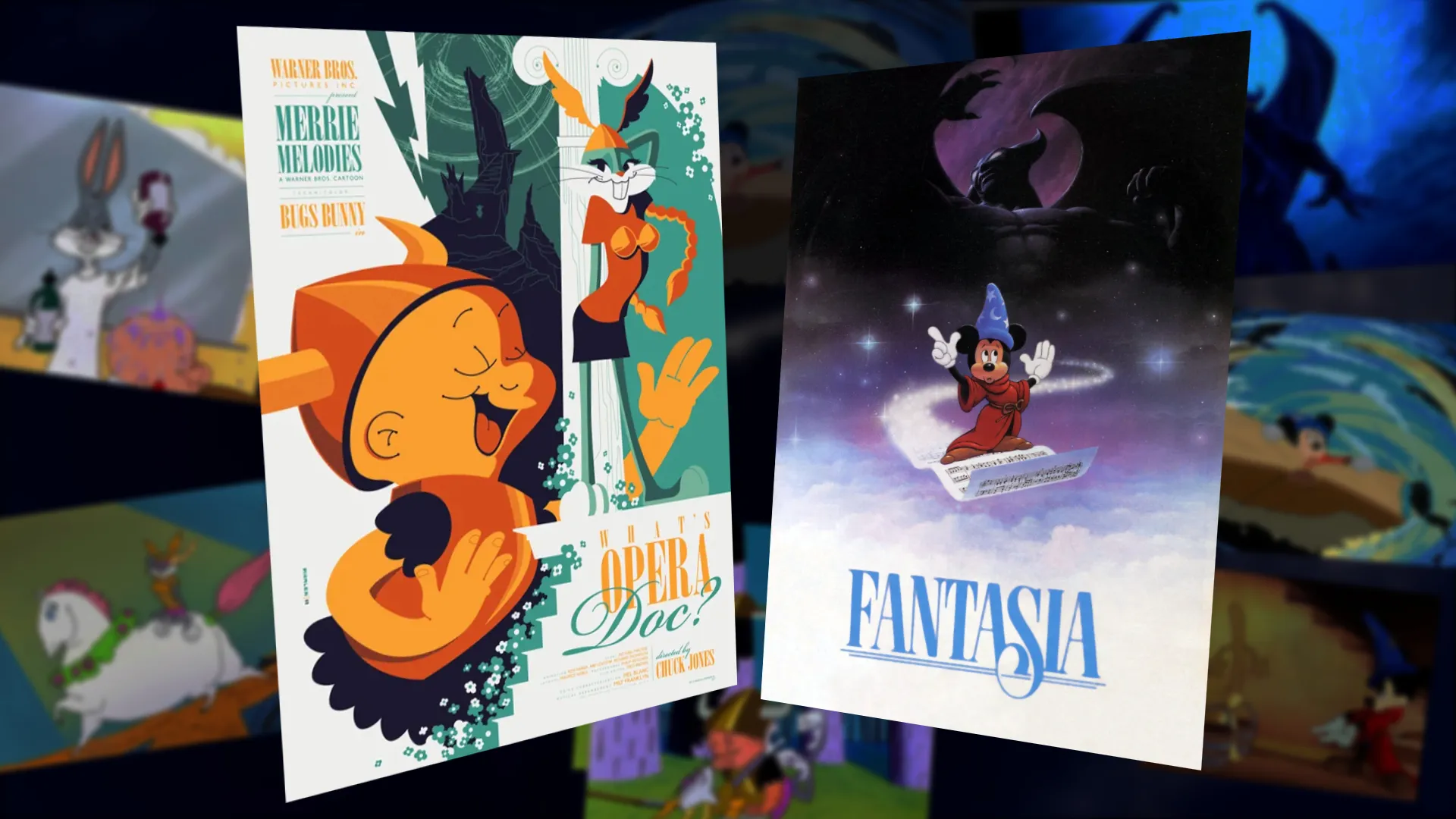
The hunter is Elmer Fudd. The rabbit is Bugs Bunny. The cartoon is What’s Opera, Doc?, a Warner Bros. short of just under seven minutes, directed by Chuck Jones in 1957, which presses Richard Wagner’s Ring cycle (four operas and some fifteen hours of music about a cursed gold ring, a dragon and the end of the gods) into a single hunt through a painted forest. Bugs escapes, for a while, by dressing as the Valkyrie Brünnhilde and riding in on a horse of tremendous girth. Milt Franklyn arranged the music from Die Walküre, Tannhäuser and The Flying Dutchman. In 1992 it became the first cartoon short chosen for the National Film Registry, the Library of Congress’s list of American films worth keeping for ever, and two years later a poll of a thousand people who work in animation named it the greatest cartoon ever made.
I have now watched it four times. I find I cannot argue with them.
The lecture
Seventeen years earlier, Walt Disney had tried to do the same thing on purpose.
Fantasia opened at the Broadway Theatre in New York on 13 November 1940. Leopold Stokowski, the celebrated conductor of the Philadelphia Orchestra, conducted eight pieces, most of them played by his own orchestra: Bach’s Toccata and Fugue in D minor, Tchaikovsky’s Nutcracker suite, Paul Dukas’s The Sorcerer’s Apprentice, Stravinsky’s The Rite of Spring, Beethoven’s Pastoral Symphony, Ponchielli’s Dance of the Hours, and Mussorgsky’s Night on Bald Mountain running into Schubert’s Ave Maria. Disney’s animators drew pictures to all of it. So that the sound should be worthy of the pictures, the studio and RCA developed a stereophonic system called Fantasound, and Fantasia became the first commercial film released in stereo.
Between the pieces stood a teacher.
Deems Taylor, a composer and music critic, appeared in evening dress before each item to explain it, and he began by sorting the programme for the audience. “Now, there are three kinds of music on this Fantasia program,” he said. “First, there’s the kind that tells a definite story.” The second kind, he went on, has no plot but paints pictures all the same. “Then there’s a third kind, music that exists simply for its own sake.”
Disney meant this to go on. He planned to re-release Fantasia every few years with one of its segments retired and a new one put in its place, so that the film would become a concert hall that changed its programme. It did not work out. The first release lost money, because the roadshow presentation and the Fantasound equipment were ruinously expensive and the war had closed the European market, and the film did not make a profit until it was re-released in 1969. Some critics were furious. Dorothy Thompson of the New York Herald Tribune wrote that she had “left the theater in a condition bordering on nervous breakdown.” Stravinsky, whose Rite of Spring had been cut and rearranged, called the musical performance “execrable.”
I happen to think Fantasia a masterpiece, and The Sorcerer’s Apprentice the finest thing the studio ever made. The problem, if there is one, is that even a very great work that would like you to know it is good for you cannot hide improving intention, and children can smell that through a closed door.
The parody
Across Los Angeles, at Warner Bros., the cartoon department noticed.
In 1943 Bob Clampett directed A Corny Concerto, which opens on Elmer Fudd as a dishevelled Deems Taylor, unshaven, in a tailcoat that does not fit, solemnly introducing two waltzes by Johann Strauss before the cartoon gets on with its jokes. It is the lecture with the lectern kicked away.
There was some history to this. The man in charge of Warner’s cartoon music, Carl Stalling, had been Walt Disney’s first music director. He scored The Skeleton Dance in 1929, the first of Disney’s Silly Symphonies, and his discussions with Disney over whether the music or the picture should come first helped bring that series about: cartoons in which the animation was built to fit the music. In 1936 he went to work for Warner’s cartoon studio and stayed for twenty-two years, scoring almost everything it released; more than six hundred films. The man who helped Disney invent the musical cartoon thus spent the rest of his career across town, doing something altogether less reverent with the same idea.
Warner’s cartoons had never been meant to improve anybody. The Merrie Melodies series began in 1931 partly as advertising: each short was contractually required to include “at least one full chorus from a Warner Bros. song”, so that the audience would go out and buy the sheet music. And Chuck Jones, the finest of Warner’s directors, liked to say that his cartoons were not aimed at children at all. “We weren’t making them for kids or for adults,” he often said. “We were making them for ourselves.” They were made for cinemas, to run before the feature, and reached children only later, through television, where they then played for decades.
So the studio did as it pleased with the classics. In Long-Haired Hare (1949) Bugs takes over a concert at the Hollywood Bowl disguised as a conductor called “Leopold”, in a wig like Stokowski’s, while the orchestra whispers the name in awe. In Rabbit of Seville (1950) he shaves Elmer, grows flowers on his head, and very nearly marries him, all to Rossini’s overture to The Barber of Seville, which Stalling trimmed and quickened to fit the cartoon but otherwise left alone. Greg Ford, the animation historian, has pointed out that its comedy depends almost entirely on how tightly the picture is synchronised to the score. That is another way of saying that it is impossible to watch the cartoon without learning the overture.
Then came What’s Opera, Doc?, for which Jones’s unit was given five weeks, took seven, and charged the extra fortnight to a different cartoon on its time cards.
I have never filled in a time card. I gather the principle is that one should not do that.
Disney put a teacher in front of the orchestra. Warner put a rabbit in the conductor's wig. Only one of them was trying to teach, and both of them did.
Did it teach?
The people who say it did are not hard to find. George Daugherty, the conductor who in 1990 put Warner’s cartoons on a Broadway stage with a live orchestra playing the scores (the show became Bugs Bunny at the Symphony, and has been touring ever since), has said that the cartoons “introduced me to the joys of classical music” when he was four and five years old. “As a kid,” he added, “I certainly didn’t realise I was getting this wonderful musical education.”
The fairest objection belongs to Peter Dobrin, who covers classical music for the Philadelphia Inquirer, and who reviewed one of those concerts in 2019 and doubted that the cartoons had made anybody a music lover on their own. “More likely,” he wrote, “it was the fact that classical music was just part of the atmosphere in the middle of the 20th century.” On this view Bugs Bunny did not bring Rossini to the children of 1950. He borrowed what was already in the air, from the radio and the concert hall and the school music room, and the children recognised it.
That is a good point, and I accept most of it. But the atmosphere Dobrin describes has thinned a great deal since, and the cartoons have not. They went on playing to children long after the broadcasting networks stopped keeping symphony orchestras of their own. A child of the 1980s who could hum the overture to The Barber of Seville very probably learned it from a rabbit holding a razor.
The pictures were already there
Why did it work at all? Why should a hunting joke sit so comfortably on Wagner, and a dancing broom on Dukas?
Taylor answered the question himself, in that opening speech, and nobody quite noticed. His first kind of music, the kind “that tells a definite story”, is where nearly all the cartoons went shopping. And a remarkable amount of it is fantasy, written as fantasy, by composers who were reading the same folklore and myth that the genre’s novelists would later raid.
Dukas wrote The Sorcerer’s Apprentice in 1897 as a setting of a ballad by Goethe, a century older, about a boy who borrows his master’s spell to make a broom fetch water and then cannot make it stop. Mussorgsky’s Night on Bald Mountain is a witches’ sabbath on St John’s Eve. Edvard Grieg wrote In the Hall of the Mountain King for Henrik Ibsen’s play Peer Gynt: it is the court of the troll king, growing louder and faster as it closes on an intruder. Tchaikovsky’s The Sleeping Beauty is a fairy tale, and when Disney filmed the story in 1959 its composer, George Bruns, spent about three years turning the ballet into a film score; the song “Once Upon a Dream” is Tchaikovsky’s Garland Waltz with words. As for Wagner, the Ring is a magic ring forged from stolen river-gold, a dragon asleep on a hoard, a sword reforged from its broken pieces, and warrior women who carry dead heroes away to the hall of the gods.
The fantasy in these pieces is not something a cartoonist added. It is the subject. The animators were simply taking the music at its word.
There is now some evidence from the listener’s side, too. In 2022 Elizabeth Margulis, who directs the music cognition lab at Princeton University, published a study with colleagues in the Proceedings of the National Academy of Sciences in which 622 people listened to 32 short pieces of instrumental music, half Western and half Chinese, and wrote down the stories they imagined. Listeners in a college town in Arkansas and another in Michigan imagined strikingly similar things. For one passage, people in both places pictured a lone cowboy in the desert sun, looking out over an empty town. Listeners in Dimen, a village in rural China with little access to Western media, heard the same passage and imagined a man from ancient times grieving for the woman he loved.
Music, Margulis concluded, “can generate remarkably similar stories in listeners’ minds”, but how far those stories are shared depends on how much culture the listeners share. It is, in the paper’s own phrase, “neither an abstract stimulus nor a universal language.”
That seems to me the most interesting thing anybody has said on the subject, because it closes the circle. The composers put the pictures into the music. The cartoons found them and drew them. And the cartoons then became part of the shared culture that tells a listener what music looks like, so that a great many people can no longer hear the Valkyries ride without seeing a rabbit on a very fat horse. The lesson ran in both directions. The cartoons taught us the music, and then they taught us the pictures.
The music at the gate
Disney, for its part, never stopped believing in any of this, and it has built the belief into its parks, where the music arrives before anything else does. This paper has written before about how Disneyland handles its doors. The music is how it handles the moment just before them.
Since 1992 Mickey Mouse has dreamed that he is the Sorcerer’s Apprentice in Fantasmic!, a night-time show on the river at Disneyland. But the best example I know is in Japan. Tokyo DisneySea opened on Tokyo Bay on 4 September 2001, and it turned twenty-five last month. Its harbours, which it calls ports rather than lands, are joined by water, and at its gate, before you have seen any of them, a great globe turns slowly above jets of water. It is called the AquaSphere, and it stands for the Earth as a water planet.
The music that plays around it was composed for the park in 2001 by Isao Tomita, and Disney could not have chosen better. Tomita, who died in 2016, was the Japanese pioneer of the synthesiser. He made his name in 1974 with Snowflakes Are Dancing, an album of Debussy’s piano pieces remade in electronic sound, which was the best-selling classical record of its year and was nominated for four Grammys. When he did the same thing to Holst’s The Planets, Holst’s daughter Imogen refused permission for her father’s music to be treated that way. So the man the Holst family would not let near the planets was given, instead, the Earth.
I think it rather a good trade.
The AquaSphere music has no story to tell and no characters to introduce. In Taylor’s terms it is the second kind, the kind with no plot that paints pictures anyway. It plays to people who have not yet seen anything, and it has one job, which is to tell them they are about to go to sea. By the time they reach the water, the music has already primed them for aquatic wonder and adventure.
The rabbit was right
Fantasia is still the better film, and Disney was right to try to teach. But the tailcoat was never necessary. Taylor’s own speech contained the whole secret, and the rabbit understood it without having to be told: the music had been about sorcerers and dragons all along, and anybody who simply drew what it was about would find that a child had learned it without noticing.
I learned my Wagner from a velvet chair, and I would not exchange the chair. I am prepared to concede that it was not strictly necessary either. Every piece of music in the fantastic repertoire is waiting for its rabbit. The ones that find one will be hummed for another century, and the rest will have to make do with the opera house.