
The sequel to Hogwarts Legacy was confirmed in August by a letter to shareholders, and it got half a sentence.
The letter was Warner Bros. Discovery’s report on the second quarter of 2026. In a passage about making its games business pay better, it listed what was coming, and the list included “the second installment of Hogwarts Legacy”. There was no title. There was no date, no platform, no picture and no studio named. Players who had waited more than three years for news were handed a subordinate clause in a financial document, and most of them, quite rightly, were delighted.
I laughed when I read it. Somewhere an accountant wrote the most anticipated line in games this year and then went back to the depreciation schedules.
For those not in the know, Hogwarts Legacy is a role-playing game set in the world of J.K. Rowling’s Harry Potter novels, about a century before Harry. It was made by Avalanche Software, a studio in Salt Lake City, Utah, and published by Warner Bros and the newly created label Portkey Games in February 2023.
In Legacy, you play a student who arrives at Hogwarts School of Witchcraft and Wizardry in the 1890s and entering the school, very unusually, as a fifth-year. You also have a rare gift for an old and dangerous kind of magic.
The game sold twelve million copies in its first two weeks. By December 2025 it had sold more than forty million, and it was the best-selling game of 2023 in the United States.
A sequel to a game like that was never really in doubt. What it will be is a different question.
What has actually been said
Gunnar Wiedenfels, then Warner Bros. Discovery’s chief financial officer, went first. At a Bank of America conference in September 2024 he called a successor to the game “one of the biggest priorities in a couple of years down the road.”
Two months later David Haddad, then president of the company’s games division, told Variety that the sequel was a “very big priority”, and that its broad storytelling was being coordinated with the Harry Potter television series HBO was making.
In March 2025 Jason Schreier, who covers the games industry for Bloomberg, reported that Warner Bros. had cancelled a story expansion for the first game, along with a Definitive Edition that would have bundled it. The expansion was not thought substantial enough to justify its price. But a studio that shelves an extra chapter usually has another whole book on the desk.
In February 2026 JB Perrette, the executive who runs the company’s games business, promised that 2027 and 2028 would bring back its biggest franchises. Then came the letter in August.
On 6 October the castle changed landlords. Paramount Skydance completed its $110 billion purchase of Warner Bros. Discovery, and the combined company now calls itself Skydance. The two companies’ games divisions are reported to be merging into one. Coverage of the merger has assumed the sequel will come through it, on the reasonable ground that it is the most valuable thing in the cupboard, and nobody in a position to say otherwise has done so.
Meanwhile the television series has a date. Harry Potter and the Philosopher’s Stone, the eight-episode first season of HBO’s adaptation, begins on Christmas Day.
That is the whole of the rather short ledger, almost every line of which was written for investors.
What is only talk
The release date is talk. The guesses run from 2027 to 2028, which is a polite way of saying that nobody knows.
The reveal is talk. GameRant has suggested The Game Awards, the industry’s big televised ceremony, on 10 December, as a likely place for a first trailer, and has sensibly told its readers not to count on it. For scale: the first game was unveiled at a PlayStation showcase in September 2020 and came out in February 2023. A trailer this winter would not mean a game next year.
The setting is the most interesting talk. The first game takes place in the 1890s. HBO’s series takes place in the 1990s. If their stories are to meet, something has to cross a hundred years, and nobody outside the two productions knows what. Some reports have suggested that the sequel’s castle could be redesigned to match the one on television. That is speculation. I would be sorry to see it, for reasons that take up the rest of this page.
The worry is talk as well, though it does have a source. In March 2024 Perrette told an investor conference that Warner Bros. wanted to move away from the “one-and-done console game” towards worlds that players would keep coming back to for years. Players heard a plan to turn the sequel into an online service, with a monthly charge and a shop in the corner, and they did not like it. In February 2025 Schreier said on a podcast that it would not be one. Avalanche has since advertised for engineers with multiplayer experience to work on an unannounced game. That could mean a great many things, including a different game altogether.
The castle is already built
The reason to be excited is not in any of the rumours. It is in the first game, and it is finished.
Avalanche worked to a rule. Stephen Dona, a technical game designer on the game, described it to the Australian site Press Start shortly before launch: “if you can see it, you can go to it.”
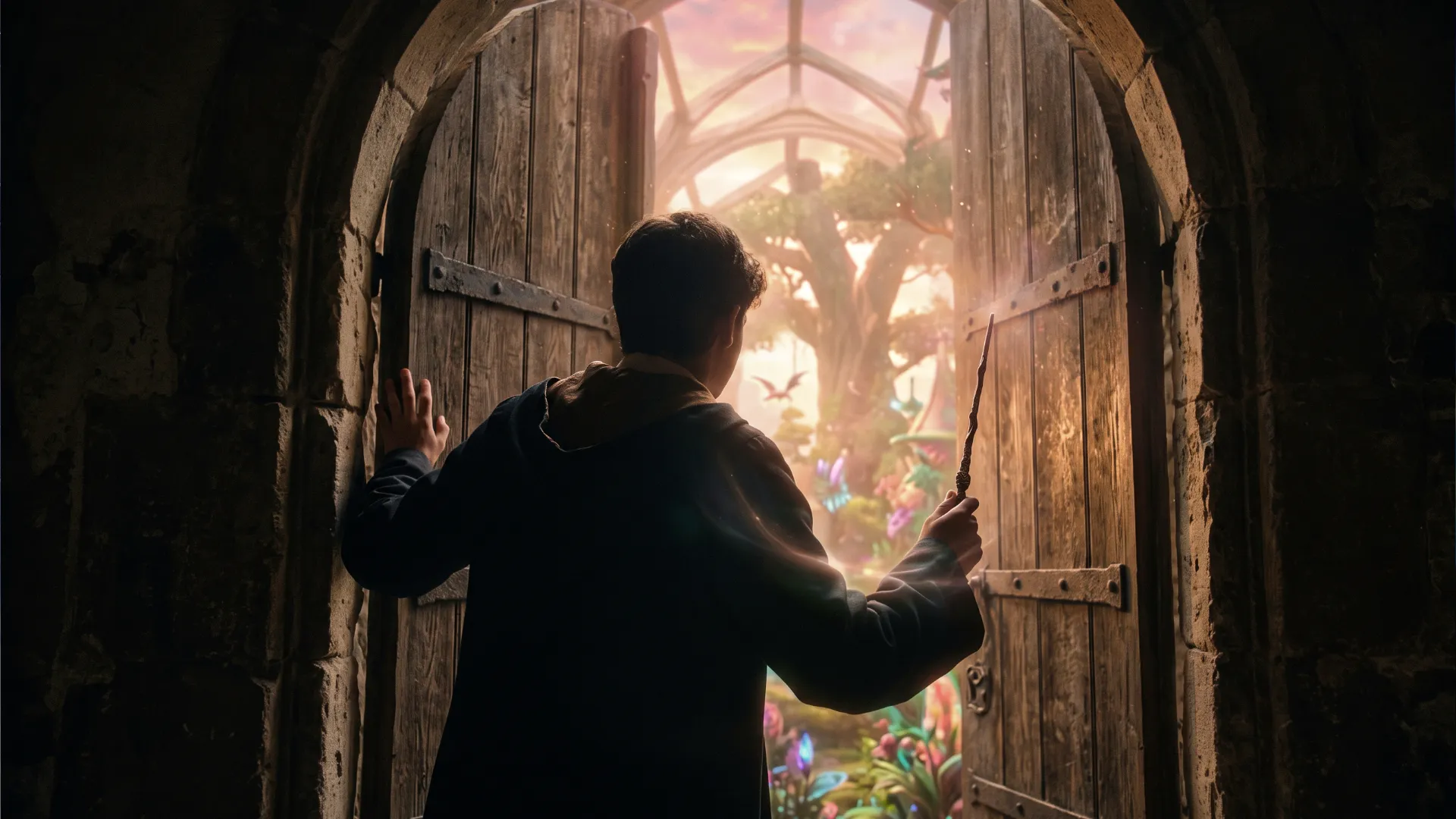
That sounds like a slogan. It is really a promise about labour. Most games build a castle the way a film set does, with a magnificent front and scaffolding behind it. A window you can see from the courtyard is a picture of a window. Avalanche decided that every window you could see from the courtyard had to have a room behind it. When the team reached parts of the building that no book or film had ever shown, Dona said, they reasoned like surveyors: “we know there are windows there, so we know there must be something there.”
Consider what that costs. Every window is a room. Every room has to be furnished. And every furnished room has to be worth the climb, or the player stops climbing.
Every window is a room. Every room has to be furnished. And every furnished room has to be worth the climb, or the player stops climbing.
Jeff Bunker, the game’s art director, has said the work began with the team rereading the books many times over, and that each new feature sent them back to the books and the films again. The places the films had used as background (the grounds, the Black Lake, the village of Hogsmeade) had to become, in Dona’s phrase, places that “always felt like a real place.”
They furnished them. The castle hides 150 loose pages of a field guide, each one a small fact about a statue, a painting or a room, often collected simply by pointing your wand at something interesting. The village and the Highlands hide some eighty more. Out in the Highlands there are 95 Merlin Trials, little puzzles set into the landscape and named for the most famous wizard in British legend. There are twelve doors in the castle that will not open until you have done their sums, written in animal symbols that stand for numbers. And there are 33 statues of the Demiguise, a shy creature that can make itself invisible. The statues glow only at night and can be collected only then, so a conscientious student ends up out of bed after hours, creeping along corridors by wand-light. The game rewards its most diligent students for breaking curfew, which made me grin.
Moira Squier, the narrative director, told the official Harry Potter site that a player might set off on a side quest and find themselves wandering the halls for forty-five minutes instead. She was being modest. One evening I set out to buy something at Honeydukes, the sweet shop in Hogsmeade, and arrived well after dark, having followed a ghost, a staircase that changed its mind and one of those doors with the sums on it. I did not buy anything. I had forgotten what I went for.
The castle also keeps time. The year turns while you are in it: the story carries you from a bright late summer through autumn, with Halloween creeping into the corridors, and into a winter of snow and Christmas decorations, and it leaves you, when it is over, in spring. Each of the four house common rooms has its own music. The score, by Peter Murray, J Scott Rakozy and Chuck E. Myers, with additional music by Alexander Horowitz, was nominated for a Grammy in 2024, and parts of it were played at the Hollywood Bowl in 2023, in a concert for the tenth anniversary of The Game Awards. I am no judge of an orchestra. I can report that I have left the game running in an empty common room purely for the sake of the music, which I have never done with any other game, and which my landlady thought very odd.
The students
The castle is the stage. The best things that happen on it happen between students.
Three of them have stories of their own that run alongside the main plot. Sebastian Sallow, a Slytherin, is searching for a cure for his sister’s curse, and his story asks how far a good friend ought to follow him. Poppy Sweeting, a Hufflepuff who would much rather spend time with magical beasts than with people, has a quarrel with the poachers who trade in them. Natsai Onai, a Gryffindor and a newcomer to the school like the player, has scores of her own to settle, and her story ends in a showdown with a dark wizard called Harlow.
Then there are the smaller errands, which are often pleasant, sometimes slightly annoying. Garreth Weasley, a Gryffindor whose aunt teaches at the school, illustrates the former. He has an idea for a new drink and needs dried Billywig stings to make it. He is fairly sure Honeydukes stocks them, but he is being watched too closely to fetch them himself, so he sends you, by way of a secret passage behind a statue of a one-eyed witch. Nothing hangs on it. Nobody’s life is at stake. It is exactly the sort of thing that fifteen-year-olds at a boarding school actually do, and the game is wise enough to let that be the whole point of the quest.
The gobstones quest is the other kind, and I will say no more of it.
The main plot however, about a goblin rebellion and a hidden store of ancient magic, does its job. It’s a typically Wizarding World type of story, providing a doorway into a lore-deepening escapade that is genuinely interesting, if a little too strung out. But that is not why people kept playing after it was over. They kept playing because there was still a window they had not been behind.
What the sequel has to keep
Whatever century the sequel is set in, and whatever HBO’s designers have done to the castle, one test will settle whether Avalanche has kept what mattered. Anybody can apply it in the first hour.
Simply go stand in a courtyard. Choose a window, high up, that nobody has pointed out to you, then go and find the room behind it. If the room is there, and there is something in it worth the stairs, the studio has kept faith with its own rule. If there is only a wall, no amount of television will make up for it.